 Image 1 of 1
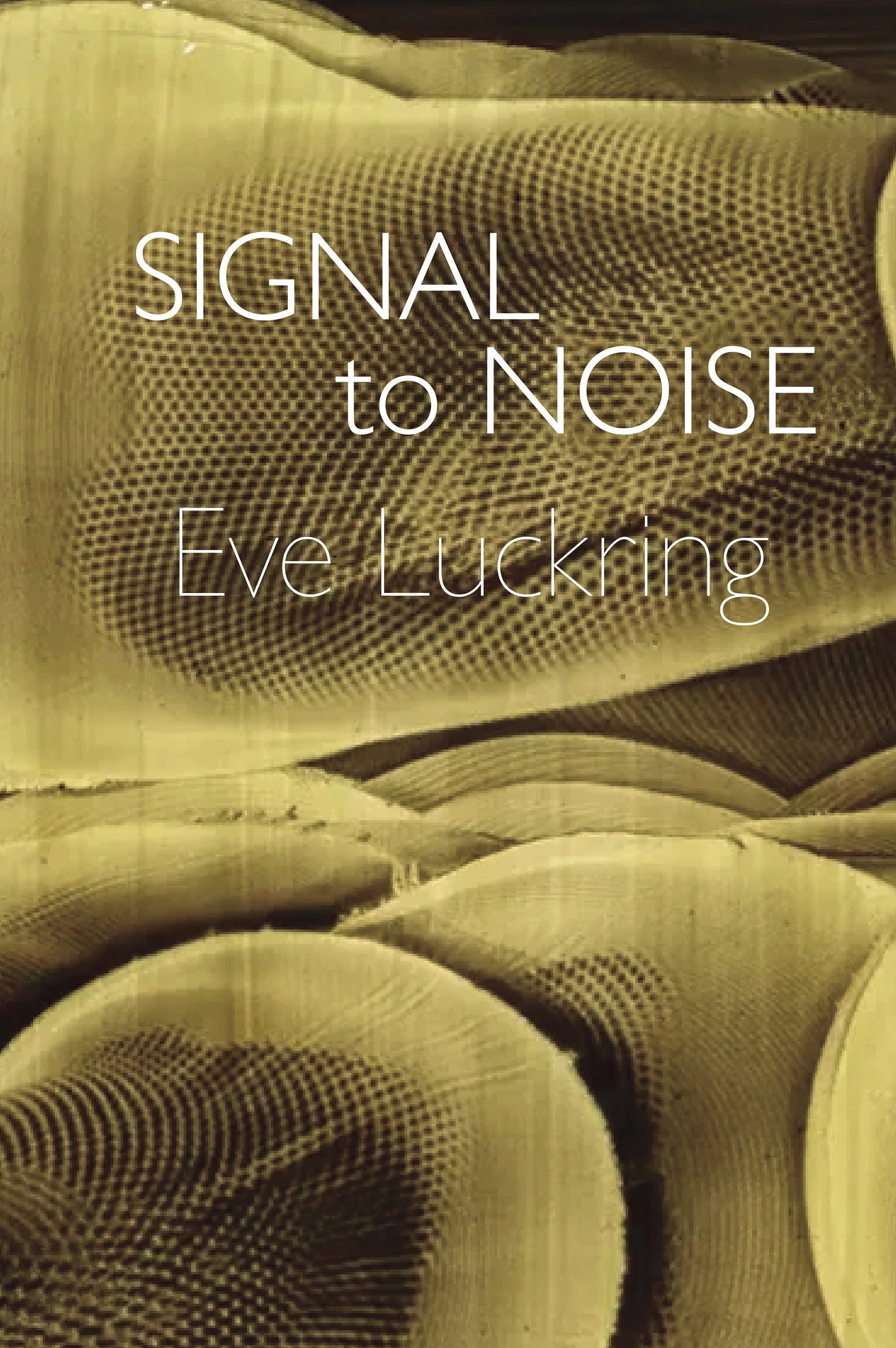
SIGNAL TO NOISE
by Eve Luckring
published October 2025
perfect bound trade paperback
9 x 6 inches, 101 pages
ISBN 978-1-942723-20-2
Signal to Noise is a haunting of the ears, a fathoming of loss, an appraisal of fragmented attention. Constructed in two parts, the book invites the reader into a state of transitional uncertainty as it navigates the interiority of grief and the precarity of living as a social being. Author Eve Luckring’s progressive hearing disability serves as a sounding board for a dissonant landscape of foiled communication. Through a continual shifting of proximities, Signal to Noise reckons with a network of contradiction, yearning, and fragility implicit to the connectivity of existence.
Praise for Signal to Noise:
“Signal to Noise creates a world of engaging and poignant poems focused on loss, loss of hearing, loss of location, loss from death, and the painful loss of a beloved. This loss is manifest in a bad phone connection, the absence of laughter, an hallucinated ‘I hear her calling my name.’ The book begins with the felt vibrations from ‘a sound I cannot hear’ and an account of traditional hearing tests in which one must repeat a given word. Luckring then cleverly skews the test to write of her estrangement: ‘Say the word fool, lose,’ or ‘writhe, numb.’ Ingeniously, loss of sound is represented in the book by blank pages punctuated by few words, each open to inventive possibilities. In the section, LEXICON words acquire new subjective definitions: INDISCERNIBLE What is the sound of complicity? Or PHASING What is the sound of attention? Judiciously and with wit Luckring makes the reader aware of the shifting nature of meaning: in prose stories; in linguistic change-ups (‘The sweet briefly of wren song’), in puzzling juxtapositions: INDECIPHERABLE : polite as fog at night/: like the mean streak in me/: this bureaucratic logic/: an excuse, withholding and beholden/: delay, deny, defend. This book wonderfully attends to painful subjects with a light and exacting touch.”
—Martha Ronk, author of CLAY bodies+matter
“‘How can we know what matters / until we know what doesn’t?’ Eve Luckring’s Signal to Noise asks us to tune ourselves toward the uncertainties of loss, and the potential of uncertainty to move in any direction. This powerful collection interrogates why we trust the language we have for all the ways we hear and are heard. Eve Luckring’s line captures both the beauty of clean language and the strata of meanings the mind must interpret when tasked with listening.”
—C.T. Salazar, author of Headless John the Baptist Hitchhiking
“This book is delirious, obsessed with meaning and the meaning of meaning. What passes for 'real life' is subsumed by a feverish uncertainty about self and the language self uses to construct itself. In attempting to block out the noise it creates its own buzz, adds to the noise, but there are also moments of clarity and calm where words resolve into a fragile simplicity with tentative, personal meanings attached. It is a liturgy of remembering, an articulation of loss, a sigh, a cry, an extended silence, an interior monologue, a simple tale of a broken relationship and sudden death, a startling, original book that 'is both signal and noise'.”
—Rupert Loydell, “Signal to Noise, by Eve Luckring,” Litter Magazine, November 18, 2025
“Composed around a narrative of a first-person responding to an unnamed ‘her,’ Luckring borrows her title from a phrase for the measure in science and engineering that compares the level of a desired signal to that of background noise; her narrative, then, pings between foreground and background, located between two singular points less fixed than simply on either side. ...Held as a long poem, a book-length pastiche of fragments and self-contained lyric and prose lyric moments that layer and accumulate, almost as a novel-in-lyric, offering pointillist moments that build into a curious kind of narrative portrait. There are elements of dream-state, suggestions of a narrator unreliable, perhaps, uncertain of where the truth might lay across her own perception.”
—rob maclennan, “Eve Luckring, Signal to Noise,” rob maclennan's blog, November 24, 2025
“Eve Luckring’s Signal to Noise grows out of her own experience of progressive hearing disability to become a study in incomprehension, or failed comprehension, or random misapprehension, which is to say it concerns language. . . .
Apart from everything else, this is writing of the highest order, the roll of sounds mimicking the tune beneath the noise in those expansive vowels. This is the signal that breaks through the surrounding noise, which is the world as it goes on around us.”
—Billy Mills, “Recent Reading January 2026: A Review,” Elliptical Movements, January 19, 2026
by Eve Luckring
published October 2025
perfect bound trade paperback
9 x 6 inches, 101 pages
ISBN 978-1-942723-20-2
Signal to Noise is a haunting of the ears, a fathoming of loss, an appraisal of fragmented attention. Constructed in two parts, the book invites the reader into a state of transitional uncertainty as it navigates the interiority of grief and the precarity of living as a social being. Author Eve Luckring’s progressive hearing disability serves as a sounding board for a dissonant landscape of foiled communication. Through a continual shifting of proximities, Signal to Noise reckons with a network of contradiction, yearning, and fragility implicit to the connectivity of existence.
Praise for Signal to Noise:
“Signal to Noise creates a world of engaging and poignant poems focused on loss, loss of hearing, loss of location, loss from death, and the painful loss of a beloved. This loss is manifest in a bad phone connection, the absence of laughter, an hallucinated ‘I hear her calling my name.’ The book begins with the felt vibrations from ‘a sound I cannot hear’ and an account of traditional hearing tests in which one must repeat a given word. Luckring then cleverly skews the test to write of her estrangement: ‘Say the word fool, lose,’ or ‘writhe, numb.’ Ingeniously, loss of sound is represented in the book by blank pages punctuated by few words, each open to inventive possibilities. In the section, LEXICON words acquire new subjective definitions: INDISCERNIBLE What is the sound of complicity? Or PHASING What is the sound of attention? Judiciously and with wit Luckring makes the reader aware of the shifting nature of meaning: in prose stories; in linguistic change-ups (‘The sweet briefly of wren song’), in puzzling juxtapositions: INDECIPHERABLE : polite as fog at night/: like the mean streak in me/: this bureaucratic logic/: an excuse, withholding and beholden/: delay, deny, defend. This book wonderfully attends to painful subjects with a light and exacting touch.”
—Martha Ronk, author of CLAY bodies+matter
“‘How can we know what matters / until we know what doesn’t?’ Eve Luckring’s Signal to Noise asks us to tune ourselves toward the uncertainties of loss, and the potential of uncertainty to move in any direction. This powerful collection interrogates why we trust the language we have for all the ways we hear and are heard. Eve Luckring’s line captures both the beauty of clean language and the strata of meanings the mind must interpret when tasked with listening.”
—C.T. Salazar, author of Headless John the Baptist Hitchhiking
“This book is delirious, obsessed with meaning and the meaning of meaning. What passes for 'real life' is subsumed by a feverish uncertainty about self and the language self uses to construct itself. In attempting to block out the noise it creates its own buzz, adds to the noise, but there are also moments of clarity and calm where words resolve into a fragile simplicity with tentative, personal meanings attached. It is a liturgy of remembering, an articulation of loss, a sigh, a cry, an extended silence, an interior monologue, a simple tale of a broken relationship and sudden death, a startling, original book that 'is both signal and noise'.”
—Rupert Loydell, “Signal to Noise, by Eve Luckring,” Litter Magazine, November 18, 2025
“Composed around a narrative of a first-person responding to an unnamed ‘her,’ Luckring borrows her title from a phrase for the measure in science and engineering that compares the level of a desired signal to that of background noise; her narrative, then, pings between foreground and background, located between two singular points less fixed than simply on either side. ...Held as a long poem, a book-length pastiche of fragments and self-contained lyric and prose lyric moments that layer and accumulate, almost as a novel-in-lyric, offering pointillist moments that build into a curious kind of narrative portrait. There are elements of dream-state, suggestions of a narrator unreliable, perhaps, uncertain of where the truth might lay across her own perception.”
—rob maclennan, “Eve Luckring, Signal to Noise,” rob maclennan's blog, November 24, 2025
“Eve Luckring’s Signal to Noise grows out of her own experience of progressive hearing disability to become a study in incomprehension, or failed comprehension, or random misapprehension, which is to say it concerns language. . . .
Apart from everything else, this is writing of the highest order, the roll of sounds mimicking the tune beneath the noise in those expansive vowels. This is the signal that breaks through the surrounding noise, which is the world as it goes on around us.”
—Billy Mills, “Recent Reading January 2026: A Review,” Elliptical Movements, January 19, 2026