
an independent publisher of poetry
Forthcoming:
The Panther and Other Poems
by Chloe Bliss Snyder
Recent Releases:

by Assem Bazzi
published June 2026
perfect bound trade paperback
9 x 6 inches, 67 pages
ISBN 978-1-942723-21-9
Endless Night is a poetry book about how the world ends and then resumes. It starts in an uncomfortable bed, wakes up in empty streets, prays for an endless night, witnesses the apocalypse, yearns for a morning after the unbearable, then finally dives back onto a pillow.
Note: If you are in Lebanon, distribution delays under the current ruinous circumstances are inevitable. Also, you are likely to pay lower shipping fees if you order from a vendor closer to home—Librairie Antoine will have copies available for sale.
Praise for ENDLESS NIGHT
“This is a document about dislocation, disembodiment and damnation. The poems abandon performative ‘resilience’ and move inwards to embrace the murky experience of mundane, impure, existence. Assem is not even interested in the Trauma Olympics of survivalist epics and the trumpeters of hope, nor the ‘poetic propagandas’ of grandeur, selective memories forged by tears and gunpowder. The empty-eyed, jaded poet/witness whispers a different song. This is a poetics of death (damnation?) in the face of those who tango on our graves and convince us that our accidental martyrdom has meaning. This is less about embracing defeat so much as choosing not to partake in the theatrics of it all.
Endless Night is a nuanced exclamation of humanity, by refusing to be enchanted by either life or death. Just recognizing that we are all fucked. It takes a different kind of courage to embrace Damnation without yielding to it.
Those who have walked in the darkness, who know the stench of ordinary death reeking from the concrete, the witnesses of hollow promises and lurking dooms, they know that the night has been, still is, and will remain. They are too familiar with the Night to be shook by it.”
—Nour M.J. Hodeib, founder of el-Yafta poetry circle
“Somewhere between Beirut and New York, a poet wanders through the streets, searching for the end of an apocalypse.
Endless Night carries the reader through a single, unbroken night where the inner and outer worlds collide. In its span, a life fractures and multiplies; from the quiet ritual of morning coffee to the brutal immediacy of war, to the hushed refuge of a library. Each moment is rendered with clarity and urgency, tracing the shifting contours of what it means to endure, to remember, and to begin again.
Bazzi moves seamlessly between the pulse of spoken word and the discipline of classical poetics, creating a voice that is both immediate and enduring, one that lingers long after the final page.”
—C.J. Raffoul, Chief Editor at Astarte Editing
Assem Bazzi discussed Endless Night with Batoul Yazbek of Al-Modon in an in-depth interview on September 12, 2026. Here is an excerpt, translated into English:
“What distinguishes Assem Bazzi is not that he is one of the few poets who write and publish poetry in English in an Arab country like Lebanon. Nor is it that he is one of those unique personalities that you rarely stumble upon in Beirut's cafés and bars. Nor is it even that he is part of the Beirut youth scene, which remains, for many outsiders, a world that is almost unknown,
Assem captivates me for more than one reason. Beyond my friendship and my fond gentle remorse for him, I see in him something outside of context, outside of time, and perhaps even outside of space. Anyone who knows Assem, the exceptionally gifted poet, knows that he is almost a complete cinematic figure: the chain smoker, the self-aware Socratic, the man with the dark sense of humor, the "New Yorker" forcibly confined to Beirut, and one of the few in this city who lives authentically, without apologizing for who he is or being overly concerned with what others think. He might even agree with them, sometimes, if he finds they have valid reasons for it.
This year, Bazzi published his second poetry book, "Endless Night", with Ornithopter Press, four years after his first book "From Martyr to Rat", with Barzakh. Between the two books, cities changed, borders closed, a pandemic struck, and crises and wars erupted, yet the nightmarish idea that began in New York continued to haunt him, even in Beirut: What if an endless night descended upon the world?”
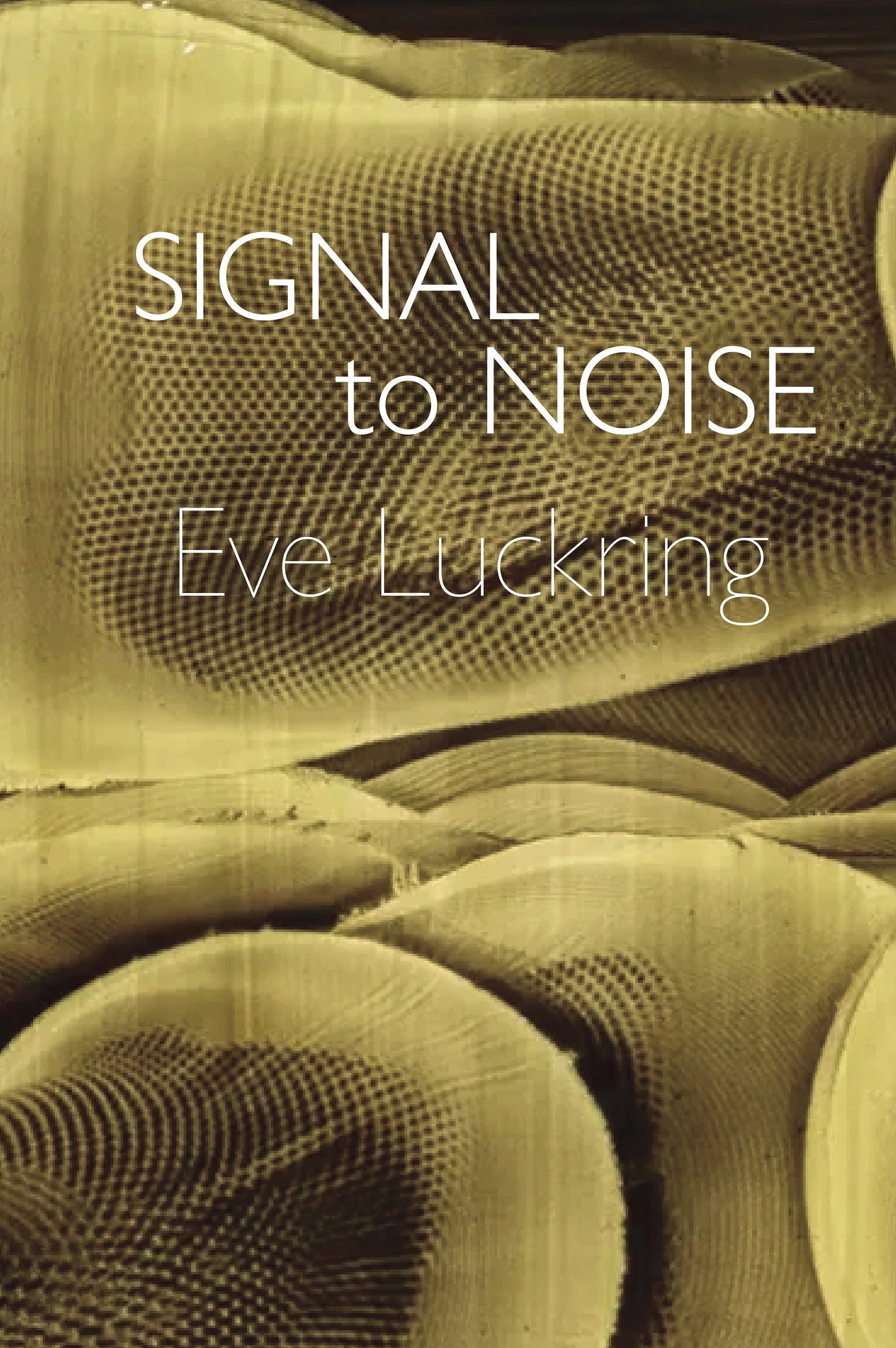
by Eve Luckring
published October 2025
perfect bound trade paperback
9 x 6 inches, 101 pages
ISBN 978-1-942723-20-2
Signal to Noise is a haunting of the ears, a fathoming of loss, an appraisal of fragmented attention. Constructed in two parts, the book invites the reader into a state of transitional uncertainty as it navigates the interiority of grief and the precarity of living as a social being. Author Eve Luckring’s progressive hearing disability serves as a sounding board for a dissonant landscape of foiled communication. Through a continual shifting of proximities, Signal to Noise reckons with a network of contradiction, yearning, and fragility implicit to the connectivity of existence.
Praise for Signal to Noise:
“Signal to Noise creates a world of engaging and poignant poems focused on loss, loss of hearing, loss of location, loss from death, and the painful loss of a beloved. This loss is manifest in a bad phone connection, the absence of laughter, an hallucinated ‘I hear her calling my name.’ The book begins with the felt vibrations from ‘a sound I cannot hear’ and an account of traditional hearing tests in which one must repeat a given word. Luckring then cleverly skews the test to write of her estrangement: ‘Say the word fool, lose,’ or ‘writhe, numb.’ Ingeniously, loss of sound is represented in the book by blank pages punctuated by few words, each open to inventive possibilities. In the section, LEXICON words acquire new subjective definitions: INDISCERNIBLE What is the sound of complicity? Or PHASING What is the sound of attention? Judiciously and with wit Luckring makes the reader aware of the shifting nature of meaning: in prose stories; in linguistic change-ups (‘The sweet briefly of wren song’), in puzzling juxtapositions: INDECIPHERABLE : polite as fog at night/: like the mean streak in me/: this bureaucratic logic/: an excuse, withholding and beholden/: delay, deny, defend. This book wonderfully attends to painful subjects with a light and exacting touch.”
—Martha Ronk, author of CLAY bodies+matter
“‘How can we know what matters / until we know what doesn’t?’ Eve Luckring’s Signal to Noise asks us to tune ourselves toward the uncertainties of loss, and the potential of uncertainty to move in any direction. This powerful collection interrogates why we trust the language we have for all the ways we hear and are heard. Eve Luckring’s line captures both the beauty of clean language and the strata of meanings the mind must interpret when tasked with listening.”
—C.T. Salazar, author of Headless John the Baptist Hitchhiking
“This book is delirious, obsessed with meaning and the meaning of meaning. What passes for 'real life' is subsumed by a feverish uncertainty about self and the language self uses to construct itself. In attempting to block out the noise it creates its own buzz, adds to the noise, but there are also moments of clarity and calm where words resolve into a fragile simplicity with tentative, personal meanings attached. It is a liturgy of remembering, an articulation of loss, a sigh, a cry, an extended silence, an interior monologue, a simple tale of a broken relationship and sudden death, a startling, original book that 'is both signal and noise'.”
—Rupert Loydell, “Signal to Noise, by Eve Luckring,” Litter Magazine, November 18, 2025
“Composed around a narrative of a first-person responding to an unnamed ‘her,’ Luckring borrows her title from a phrase for the measure in science and engineering that compares the level of a desired signal to that of background noise; her narrative, then, pings between foreground and background, located between two singular points less fixed than simply on either side. ...Held as a long poem, a book-length pastiche of fragments and self-contained lyric and prose lyric moments that layer and accumulate, almost as a novel-in-lyric, offering pointillist moments that build into a curious kind of narrative portrait. There are elements of dream-state, suggestions of a narrator unreliable, perhaps, uncertain of where the truth might lay across her own perception.”
—rob maclennan, “Eve Luckring, Signal to Noise,” rob maclennan's blog, November 24, 2025
“Eve Luckring’s Signal to Noise grows out of her own experience of progressive hearing disability to become a study in incomprehension, or failed comprehension, or random misapprehension, which is to say it concerns language. . . .
Apart from everything else, this is writing of the highest order, the roll of sounds mimicking the tune beneath the noise in those expansive vowels. This is the signal that breaks through the surrounding noise, which is the world as it goes on around us.”
—Billy Mills, “Recent Reading January 2026: A Review,” Elliptical Movements, January 19, 2026
by Chloe Bliss Snyder
publication date: November 1, 2026
(pre-orders will ship slightly prior to November 1)
perfect bound trade paperback
9 x 6 inches, 79 pages
ISBN 978-1-942723-22-6
The poems in Chloe Bliss Snyder's debut collection are like entries in a modern bestiary. Fraught with danger, desire, and mysterious mating season dances, the verses of The Panther and Other Poems are animated by lyric and erotic intensity. By turns playful and sincere, self-conscious and self-abandoning, these poems, in love with love, in love with poetry, twirl dizzyingly around their centerpiece "The Panther," a masterful and evocative elaboration on the dream-vision tradition.
Praise for The Panther and Other Poems
“Like Eros, these lyrics flirt and fling with exuberant desire, aching across lines and the gaps between rhymes and near rhymes; a lover reached for, yearned for as the verse turns over. If Snyder is a fool for love, she is a master-mistress of the lyric form, stretching it into a breathless performance of hope and joy, denial and frustration. These poems swoon with Sappho and revel like Herrick; an offering to her gods Venus and Apollo. The panther will thrill your heart as it rips it out.”
—Martin Corless-Smith, author of Golden Satellite Debris